

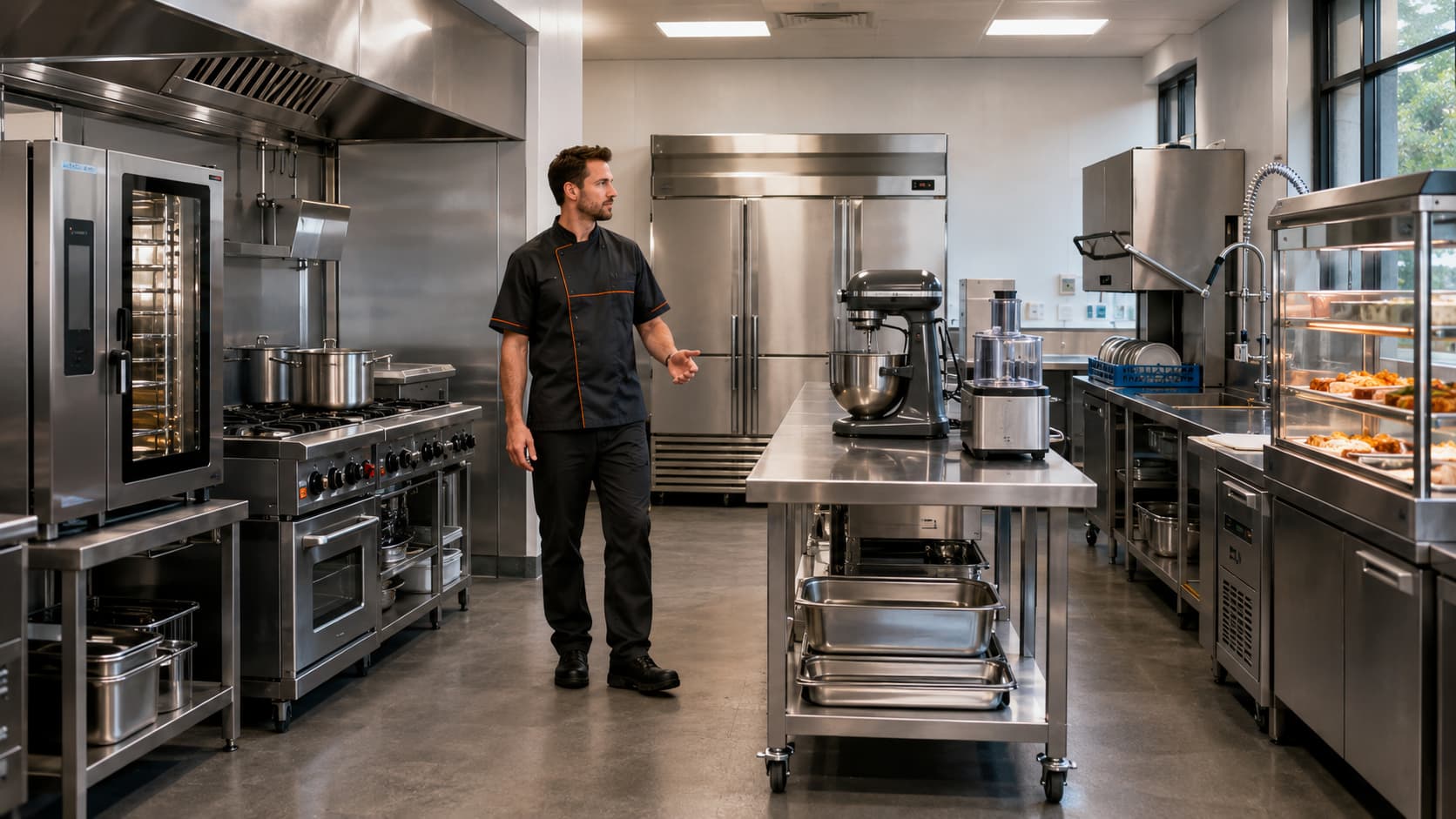
Commercial catering equipment covers everything used to store, prepare, cook, hold, serve and clean up in a professional kitchen. It splits into eight main categories: cooking, refrigeration, warewashing, food preparation, food display and holding, beverage, bakery, and benches and storage.
Knowing what sits in each category, and what separates one type from another, is what stops you buying the wrong machine for your menu. A convection oven and a combi oven look similar in a catalogue and behave very differently in service.
This guide runs through every category, what each piece of equipment actually does, and the specifications that matter when you compare models.
Commercial vs Domestic Equipment
The first distinction is the one that catches new operators. Commercial equipment is built for continuous duty, made from materials that can be cleaned and sanitised, and rated to hold safe food temperatures under real service conditions.
| Difference | Why it matters |
|---|---|
| Duty cycle | Built to run all day, every day, rather than a few hours at home |
| Materials | Stainless steel and impervious surfaces that meet food premises requirements |
| Temperature performance | Holds temperature when the door opens fifty times an hour |
| Capacity | Sized in GN pans, trays and covers rather than family portions |
| Serviceability | Parts availability and technician support, which decides how long a breakdown lasts |
| Warranty | Commercial warranties cover commercial use. Domestic warranties void in a business |
Domestic gear in a commercial kitchen is also a compliance problem, not just a durability one. A household dishwasher cannot reach commercial sanitising temperatures, and a household fridge will not hold 5°C through a lunch rush.
Cooking Equipment
Commercial cooking equipment is usually the largest single line in a kitchen budget and the one that sets your ventilation requirements.
| Type | What it does |
|---|---|
| Combi ovens | Combine convection heat and steam in one cavity. Roast, bake, steam, regenerate and hold from a single unit |
| Convection ovens | Fan-forced dry heat. The workhorse for baking, roasting and reheating |
| Pizza ovens | Deck, conveyor and stone-base options depending on volume and style |
| High speed ovens | Combine microwave, convection and impingement to cook in a fraction of the time |
| Ranges, cooktops and grills | The open cooking line. Gas burners, solid tops, chargrills and griddle plates |
| Deep fryers | Sized by oil capacity and recovery time, which decide how fast you can cook back to back baskets |
| Multifunction cooking pans | Braising, boiling, frying and pressure cooking in one unit, replacing several pieces of gear |
| Exhaust canopies | Extract heat, steam and grease-laden vapour. Sized to the equipment underneath |
What to compare:
- Gas or electric, and whether the site has the supply for either.
- Tray or GN pan capacity against your peak covers.
- Recovery time, which matters more than headline output in a busy service.
- Controls, from simple dials through to programmable and self-cleaning models.
- Footprint and clearances, including whether it needs to sit under a canopy.
Brands you will see across this category include Rational, Convotherm, Waldorf, Blue Seal, Goldstein and Turbofan.
Refrigeration and Freezers
Commercial refrigeration is the category most kitchens underbuy. You need cold storage in three places at once: bulk stock at the back, working stock at the bench, and product on display.
| Type | What it does |
|---|---|
| Upright fridges | Bulk cold storage. Solid door for back of house, glass door where staff need to see stock |
| Freezers | Upright and chest units for frozen stock, bakery product and ice cream |
| Under-bench and prep fridges | Cold storage at the station, often with a refrigerated top for sandwich or pizza prep |
| Blast chillers and freezers | Pull cooked food through the danger zone fast, which is what makes cook-chill possible |
| Ice machines | Rated by daily kilogram output and bin capacity. Cube, flake and nugget types suit different uses |
| Refrigerated drawers | Cold storage built into the line, switchable between fridge and freezer on some models |
What to compare:
- Climate rating, since a unit rated for a mild climate will struggle in a hot kitchen or a tropical site.
- Self-closing doors and door seals, which are the first thing to fail and the easiest to fix.
- Energy consumption, because refrigeration runs 24 hours a day and never gets switched off.
- Serviceability, since a fridge failure means lost stock as well as lost trade.
Common brands include Skope, Williams, Hoshizaki, Scotsman and Irinox.
Warewashing
Wash-up is where service backs up when the machine is undersized. Commercial dishwashers and glasswashers are sized by racks per hour and by how they are loaded.
| Type | Best suited to |
|---|---|
| Under-counter | Cafes, small bars and venues with limited space |
| Pass-through (hood type) | Restaurants and pubs turning tables through a full service |
| Conveyor | High volume operations, function venues and institutional kitchens |
| Glasswashers | Bars and any venue where glassware turnover is separate from crockery |
| Pot washers | Kitchens producing enough pans and trays to tie up a staff member at the sink |
Check the cycle time against your peak, not the average. A machine that finishes a rack in two minutes behaves very differently at 10am to one that takes three. Hobart, Washtech and Eswood are the names you will come across most.
Food Preparation Equipment
Food preparation equipment takes labour out of the repetitive jobs. The right question is not what looks useful, but which task your team repeats every single day.
- Food processors for bulk chopping, slicing, dicing and emulsifying.
- Planetary and spiral mixers for doughs, batters and large volume mixing.
- Meat slicers for portioning smallgoods in house.
- Vacuum pack machines for sous vide, portioning and extending shelf life.
- Scales for portion control and consistent food costing.
Robot Coupe dominates the processor category, and mixer capacity is usually quoted in litres, so match it to your biggest single batch rather than your average one.
Food Display and Holding
This category does two jobs at once: it holds food at a safe temperature and it sells the food to the customer. Food display and holding equipment has to do both properly.
| Type | What it does |
|---|---|
| Bain maries | Hold hot food in GN pans at 60°C or above, wet or dry heat |
| Hot food displays | Heated glass cabinets for pies, pastries and hot savouries |
| Cake and cold displays | Refrigerated cabinets for cakes, slices, sandwiches and salads |
| Grab and go units | Open-front refrigerated display for self-service takeaway |
| Heat lamps | Hold plated food at the pass for the short window before it leaves |
| Plate warmers | Keep crockery warm so hot food stays hot on the way to the table |
Beverage and Bar Equipment
For cafes, this category is the engine room. Beverage and bar equipment covers everything from the espresso machine to the ice.
- Espresso machines, specified by group head count and boiler size.
- Coffee grinders, with a second unit for decaf on any real coffee program.
- Blenders and juicers for smoothies, frappes and fresh juice.
- Hot water urns and boiling units to take tea service off the coffee machine.
- Slushie and granita machines for venues with a strong summer trade.
Bakery and Bench Top Equipment
Bakery equipment covers the gear that makes on-site baking possible: deck and rack ovens, provers and retarder provers, dough moulders, dividers, pastry sheeters and bread slicers. Baking in house changes your rosters and your storage as much as your equipment list, so cost the whole picture.
Bench top equipment is the smaller gear that sits on the line and does one job well.
| Equipment | Typical use |
|---|---|
| Sandwich presses | Toasties, paninis and wraps, with ribbed or flat plates |
| Conveyor toasters | Continuous toast output through a breakfast rush |
| Salamanders | Melting, browning and finishing plates before they go out |
| Induction hobs | Fast, controllable heat where gas is not available |
| Griddles | Eggs, bacon, pancakes and burgers on an open plate |
| Soup kettles and rice cookers | Holding single products hot and ready through service |
Roband, Woodson and Moffat cover most of what sits in this category in Australian kitchens.
Benches, Sinks and Storage
Not exciting, but it is what the kitchen is built on. Stainless benching and storage has to be specified alongside the equipment, because appliances that arrive with nowhere to sit end up on the floor.
- Modular stainless benches, which are cheaper than custom and suit standard runs.
- Custom fabrication for odd corners, short runs and equipment cut-outs.
- Hand basins, sinks and pot sinks, including the dedicated hand wash basin the Food Standards Code requires.
- Shelving that keeps dry goods off the floor and allows cleaning underneath.
- Trolleys for deliveries, stock moves and clearing.
Simply Stainless modular systems cover most standard requirements, with fabrication filling the gaps.
Matching Equipment to Your Venue
Same categories, very different lists depending on what you run.
| Venue | Where the spend concentrates |
|---|---|
| Cafe | Coffee equipment, refrigerated display, under-bench refrigeration, bench top cooking |
| Restaurant | Full cooking line, combi oven, multiple fridges, pass-through warewashing |
| Pub or club | Fryers and grills, glasswashers, bain maries, bulk cold storage |
| Bakery | Deck or rack ovens, mixers, provers, retarder provers, bakery freezers |
| Takeaway or food truck | Compact bench top cooking, hot holding, under-bench refrigeration |
| Aged care, health and education | Combi ovens, blast chillers, bulk food transport and meal delivery systems |
Whatever the venue, specify the equipment against your menu and your peak service rather than your floor area. MVO Services is a full-service commercial catering equipment supplier, stocking cooking, refrigeration, warewashing, preparation, display, bakery and beverage equipment from leading brands, with in-house technicians, stainless steel fabrication and Australia-wide delivery.
Need help specifying your equipment?
Browse the full range of commercial catering equipment, or talk to the MVO Services team about your kitchen.


