

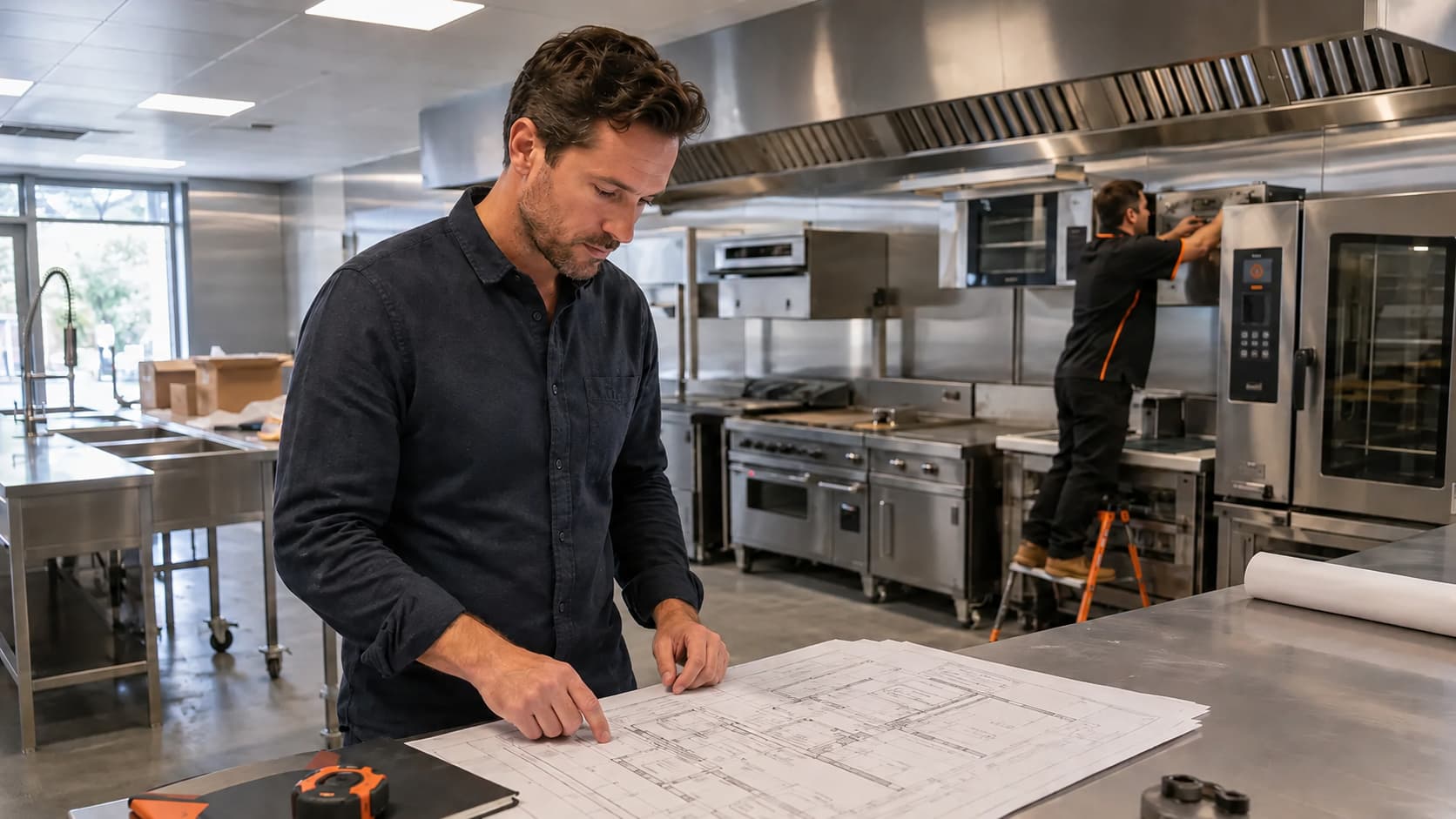
A commercial kitchen is the most expensive part of any hospitality fit-out, and the part most likely to blow the budget. As a rough guide for 2026, a small cafe kitchen runs from around $50,000 to $200,000, a full restaurant kitchen from $200,000 to $500,000, and a large production or hotel kitchen $750,000 and up.
Those ranges are wide because a kitchen is priced on what it produces, not on floor area. Two 60 square metre kitchens can land hundreds of thousands apart depending on the cooking line, the ventilation and what services the site already has.
This guide breaks the spend into its parts, shows where the money actually goes, and flags the costs that catch operators out after the lease is signed.
What the Numbers Cover
Before comparing quotes, be clear on what is inside the figure. Most builders quote construction and services separately from equipment, and equipment usually accounts for 40 to 60 percent of the total project.
| Cost group | What it includes |
|---|---|
| Construction and services | Walls, floors, drainage, plumbing, electrical, gas, ventilation, fire compliance |
| Equipment | Cooking, refrigeration, dishwashing, preparation, display and stainless benching |
| Design and approvals | Kitchen design, mechanical engineering, certification and council approvals |
| Soft costs | Freight, installation, commissioning, staff training and spares |
A quote that looks cheap is often a quote with a smaller scope. Always confirm whether ventilation, grease arrest and equipment installation are in or out before you compare two numbers.
Fit-Out Cost by Kitchen Type
These are indicative 2026 ranges for the construction and services side of an Australian commercial kitchen, before equipment.
| Kitchen type | Indicative construction cost |
|---|---|
| Small cafe kitchen, 20 to 40 sqm | $50,000 to $200,000 |
| Restaurant kitchen, 60 to 100 sqm | $200,000 to $500,000 |
| Large, high-volume or production kitchen | $750,000 and above |
On a per square metre basis, basic kitchens and renovations tend to sit around $1,500 to $3,000 per sqm, mid-range kitchens $3,000 to $5,000, and large production kitchens $5,000 to $8,000 or more.
The rate does not drop much as the kitchen gets bigger, because the expensive parts are driven by output rather than floor space. Ventilation, refrigeration, drainage and equipment all scale with what you cook, not with how many square metres you rent.
Where the Equipment Budget Goes
Equipment is the single biggest line in most projects. As a working guide, a small cafe lands around $30,000 to $50,000 of commercial catering equipment, a mid-size restaurant $80,000 to $150,000, and a large or high-volume kitchen $200,000 and up.
| Category | What drives the spend |
|---|---|
| Cooking equipment | Size of the cooking line. A combi oven alone can cost more than an entire small cafe cooking setup |
| Refrigeration | Number of cold points. Under-bench, upright, display and cool room all add up quickly |
| Dishwashing | Under-counter units are entry level. Pass-through and conveyor machines cost several times more |
| Stainless benching and shelving | Modular flat pack is cheapest. Custom fabrication costs more but suits awkward spaces |
| Food display and holding | Counter presence for cafes and takeaway venues. Refrigerated display costs more than hot |
| Coffee and beverage | Machine group count and grinder quality. A serious coffee program is a serious line item |
| Food preparation | Mixers, processors and slicers, depending on how much you make in house |
To put one item in perspective, a countertop convection oven can start under $1,000 while a full-size double stack runs into the tens of thousands. The gap between a modest spec and a premium one across a whole kitchen is where two identical floor plans end up $50,000 apart.
Ventilation Is the Line That Surprises People
Exhaust is the most commonly underestimated cost in a kitchen fit-out. The exhaust canopy itself is only part of the system. Ductwork, the fan, make-up air and fire suppression all sit behind it.
| Item | Indicative cost |
|---|---|
| Canopy supply only | $2,000 to $10,000 depending on size and type |
| Installed system, small cafe or takeaway | $8,000 to $15,000 |
| Installed system, mid-size restaurant | $15,000 to $28,000 |
| Installed system, large kitchen | $28,000 to $45,000 or more |
| Exhaust engineering and design | $3,000 to $8,000 for sizing, drawings and certifier documentation |
| Ongoing cleaning | $1,500 to $3,000 a year for a mid-size system |
Ductwork is the biggest variable, commonly a quarter to 40 percent of the install. A long run through a multi-level building costs far more than a short run straight through an external wall, which is worth checking before you sign a lease.
Australian kitchen exhaust is designed to AS 1668.2 for ventilation and make-up air, and AS 1668.1 for fire and smoke control. Undersized systems fail certification, so this is not a place to shop on price alone.
Services, Drainage and Compliance
The condition of the site drives a large share of your budget. A former food premises with services already in place is cheaper to convert than a bare shell or a retail tenancy that has never had a kitchen.
Key considerations:
- Grease arrest. Adding a grease trap and new drainage points where none exist can add tens of thousands.
- Electrical capacity. Three-phase power and an upgraded switchboard are common requirements for combi ovens and dishwashers.
- Gas supply. If gas is not available or pressure is inadequate, your cooking line changes and so does the cost.
- Fire suppression. Wet chemical systems over the cooking line are standard on a full canopy install.
- Surfaces. Commercial-grade floors, coving and wall finishes are required in food areas and are not cheap.
Get a feasibility check on the site before you commit to the lease. A cheaper rent on a difficult tenancy is often more expensive once the services are priced.
Costs People Leave Out of the Budget
Fit-out quotes cover the build. Plenty of real costs sit outside them, and they land at the worst possible time.
| Cost | Why it matters |
|---|---|
| Make-good clause | The cost of returning the premises to its original state at lease end. Often ignored at signing |
| Lease bond and advance rent | Tied up before you trade a single dollar |
| Freight and installation | Large equipment needs delivery access, positioning, connection and commissioning |
| Smallwares | Pans, crockery, cutlery, containers and cleaning gear add up fast and are rarely quoted |
| Post-construction clean | Required to commercial kitchen standard before you can prepare food |
| Staff training | New combi ovens and coffee machines only pay off if the team can drive them |
| Contingency | Ten to fifteen percent, because something always comes up once walls are opened |
Lead times deserve their own line in the plan. Commercial kitchen equipment and imported materials commonly run 8 to 16 weeks, so ordering late means paying a premium for stock on hand or pushing back your opening date. Every week you are not trading is rent with no revenue against it.
How to Keep the Budget Under Control
Most overruns come from decisions made too late rather than from prices being too high.
- Lock the menu before you design the kitchen. Menu changes late in the process move gas, power and exhaust.
- Design the layout properly at the start. Moving a drainage point after the slab work is done is expensive.
- Get the equipment list specified before you tender the build, so the builder is pricing the real job.
- Spend where failure hurts. Refrigeration, dishwashing and your main cooking unit are the wrong places to save.
- Be honest about capacity. Buying for a volume you will not hit for three years ties up cash you need now.
- Check the service network on the brands you buy, because parts availability decides how long a breakdown lasts.
Running costs are part of the picture too. Gas cooking equipment generally runs 20 to 30 percent cheaper per hour than electric at current Australian commercial tariffs, and a full-size oven can cost $1,500 to $5,500 a year in energy on its own. Over a ten year life, the cheaper unit is not always the cheaper decision.
Paying For It
Not every fit-out has to be funded from cash. Equipment finance and rental options spread the cost across the life of the gear, which usually suits cash flow better than opening underequipped and replacing things in year two.
Weigh up the options against how long you expect to hold the equipment, what your accountant says about depreciation and instant asset write-off, and how quickly the business is likely to grow into a bigger spec.
Every site prices differently, and the only number worth budgeting against is the one produced after someone has walked your premises. MVO Services supplies, installs and services commercial kitchens across Australia, with in-house technicians, refrigeration mechanics and electricians, plus stainless steel fabrication for spaces that do not suit standard sizes.
Costing a kitchen fit-out?
Browse the full range of commercial catering equipment, or talk to the MVO Services team about your project and get a quote based on your site.


